


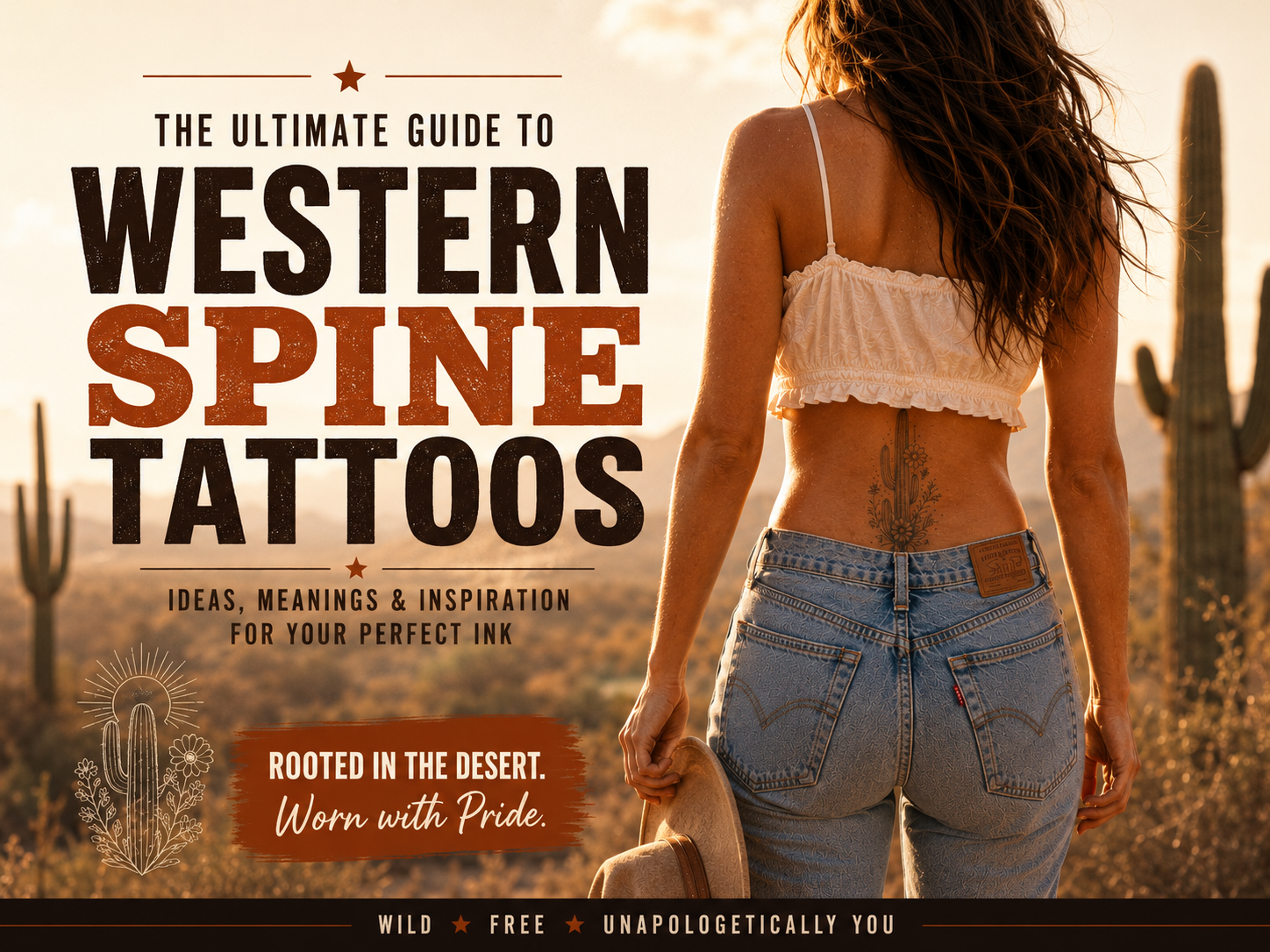
The spine is the most naturally cinematic tattoo placement on a woman’s body. It elongates. It reveals itself in backless dresses, crop tops, and the specific moment a woman turns away from you. Western imagery on the spine takes this cinematic quality and gives it a narrative: a cactus climbing toward the sun, a cowgirl silhouette against the horizon, a trail of desert wildflowers ascending toward the shoulders, a vine of barbed wire with small roses framing the vertebrae. The combination of the western aesthetic with the spine’s inherent elegance creates something genuinely distinctive in the tattoo world. Neither purely feminine nor purely rugged. Exactly in between, which is exactly where the best things live.
This guide is the most complete resource available on western spine tattoos for women. We cover why the spine suits western imagery so well, the full meaning of every major western design element, every specific design concept organized for the vertical canvas, how to stack and compose elements along the spine for visual flow, style options and what each brings to the subject, the honest pain truth by spinal zone, aftercare, and how to find an artist who understands both western aesthetic and large-format spine work. By the end, you will know exactly which western spine tattoo is yours.
Key Takeaways
- Western spine tattoos for women are one of the most distinctive tattoo concepts in contemporary body art because they combine the rugged romanticism of the American West with the spine’s naturally elongating and cinematic placement.
- The most popular western spine tattoo designs for women are blooming cactus compositions, stacked western elements (boots, hat, rose, barbed wire), desert wildflower columns, cowgirl silhouettes, and single-stem botanical western designs.
- Vertical alignment is everything. Western elements must be chosen and composed to flow naturally along the spine’s vertical axis. Designs that work horizontally on the forearm or chest need compositional adjustment to succeed on the spine.
- Fine line and illustrative styles are the most popular for women’s western spine tattoos because they suit the placement’s elongating quality and the delicate femininity many women want from this combination.
Why the Spine Is the Perfect Canvas for Western Tattoo Designs
The Vertical Format of Western Imagery
Western imagery has a naturally vertical character that the spine captures better than any other placement. Cacti grow upward. Sunsets rise from the horizon. A cowgirl silhouette stands against the sky. A lone trail climbs through a canyon. The American West’s most iconic visual elements all reach vertically, which means they align with the spine’s axis in a way that feels compositionally natural rather than forced.
A cactus climbing from the lower spine to the upper back is not a design placed on a canvas. It is a design that grows with the canvas. A column of desert wildflowers ascending the vertebrae follows the same logic: the botanical form’s natural upward direction mirrors the spine’s directional pull. This vertical coherence between western subject matter and spinal anatomy is what makes this combination so visually successful.
The Elongating and Cinematic Effect
The spine tattoo’s most celebrated quality is the elongating effect it creates on the female silhouette. A well-composed vertical design draws the eye along the full length of the back, emphasizing its natural curve and the waist’s natural narrowing. Western imagery serves this function particularly well because the subjects that suit the spine are inherently tall and upward-reaching rather than wide and horizontal.
The reveal moment of a spine tattoo, the instant the back is visible in a backless dress or a low-cut top, is one of the most cinematically powerful tattoo reveals available. Western imagery makes this reveal specifically evocative: the glimpse of a climbing cactus or a stacked western composition produces an immediate, specific aesthetic impression that connects to an entire cultural aesthetic of freedom, independence, and the romantic American West.

Visibility in Western-Influenced Fashion
The current western fashion revival, with its cowboy boots, wide-brim hats, fringe jackets, and Southwestern color palettes, has created a wardrobe context that makes a western spine tattoo particularly potent. A backless western-style top, a crop top with high-waisted jeans and cowboy boots, or an open-back dress paired with western accessories creates a complete aesthetic where the spine tattoo becomes the central and most personal element.
The spine’s natural concealment in professional settings and reveal in casual, summer, and country music festival contexts mirrors the western woman’s own dual nature: understated in some rooms, unmistakably herself in others.
What Do Western Spine Tattoos Mean?
Freedom and the Open Road
The western aesthetic is built on a single overriding value: freedom. The open range, the uncharted territory, the horizon that keeps retreating as you ride toward it. Western tattoos on women represent the same declaration that the frontier represented to the women who navigated it: I will not be contained by anyone’s expectation of what I should be or where I should stay.
A western spine tattoo carries this freedom declaration in one of the most personal placements available. The spine is not a placement for public performance. It is a placement that reveals itself on your terms, in the moments you choose, to the people you choose to show it to. That selective revelation is its own expression of the western freedom value: freedom exercised with intention rather than simply announced.
Feminine Strength and Cowgirl Identity
The cowgirl is one of the most potent symbols of feminine strength in American cultural history. Cowgirls much like the cowboys traveled long distances on horseback and explored new horizons. In many cultures, cowgirl images were used to start a rebellious streak against pre-established norms and conventions. These tattoos are prominent symbols of individuality: worn by women who express their wish to stand out and live on their own terms.
Most importantly, cowgirl motifs popularize the idea of women’s empowerment. The designs exemplify the fact that women are equally capable and deserving. A western spine tattoo honors this specifically western form of feminine power: strength that does not apologize for itself, independence that does not require permission, and the specific pride of a woman who knows how to handle what the world throws at her.

Resilience and Survival in Harsh Conditions
The cactus, one of the most popular western spine tattoo elements, carries one of the most honest metaphors in the tattoo vocabulary. A cactus survives without regular water. It thrives in conditions that would kill most other living things. It produces flowers of extraordinary beauty from the most hostile possible environment. It can wound those who handle it carelessly but nourishes those who know how to approach it.
A blooming cactus on the spine is a declaration about the wearer’s specific form of resilience: the ability to find beauty within difficulty, to survive conditions that others cannot, to produce something worth looking at despite everything that has tried to prevent it.

Connection to the Land and Western Heritage
Western tattoos represent a specific connection to place: the American West’s landscapes, its particular quality of light, its specific combination of vastness and intimacy. For women with roots in Texas, Oklahoma, Wyoming, Colorado, Montana, or any of the western states, a western spine tattoo connects personal identity to ancestral geography. It says: I know where I come from. That place shaped me. It is as much a part of who I am as anything I have chosen.
Even for women without western geographic roots, the aesthetic carries cultural meaning. Country music, western fashion, rodeo culture, and the mythology of the American frontier have created a set of shared symbols that speak across regional boundaries to a specific set of values: hard work, authenticity, connection to the natural world, and the specific beauty of things that are a little rough around the edges.
Nostalgia and the Romantic Ideal of the American West
Western tattoos evoke a sense of nostalgia, allowing wearers to tap into the magic and power of an era that continues to spark awe and wanderlust. They offer a captivating blend of nostalgia and unbridled freedom, symbolizing an admiration for the rebellious spirit and untamed landscapes of the Wild West. For women drawn to the romantic aesthetics of a golden era of independence, trail rides, and sunsets over open country, a western spine tattoo creates a permanent tribute to the feeling that era represents.
Western Spine Tattoo Design Ideas for Women
Cactus Spine Tattoos
A single tall saguaro cactus rising from the lower spine toward the upper back is one of the most compositionally perfect western spine tattoo designs available. The saguaro’s distinctive silhouette: tall central column with outstretched arms at specific heights, translates directly to the spine’s vertical axis. The cactus grows along the back as naturally as it would grow from desert soil.
In fine-line execution, a saguaro with detailed spine texture and subtle shading creates a design of genuine botanical elegance. In blackwork, the graphic silhouette creates bold, immediate visual impact. Both approaches suit the placement and both honor the subject’s honest symbolism: I have grown in conditions that were not designed for my comfort, and I am still standing.

Blooming Cactus Spine Tattoos
A blooming cactus spine tattoo adds flowers to the cactus form, creating a design that combines the subject’s rugged survival symbolism with the specific beauty of bloom. This design is ideal for those who want a unique and eye-catching tattoo that embodies the spirit of the West. The flower rendered at the cactus crown, perhaps in hues of muted red or dusty rose, emphasizes the hope and vitality that emerge even in harsh climates.
Crisp lines and vivid shading bring the ruggedness of the cactus to life while the flower softens and beautifies the overall composition. For women who want their western spine tattoo to balance strength and femininity in a single image, the blooming cactus achieves this more completely than almost any other design.

Cowgirl Silhouette Spine Tattoos
A cowgirl silhouette at the base of the spine, perhaps standing or on horseback, facing toward the upper spine as though riding toward the horizon, creates one of the most personally resonant western spine designs. A cowgirl with a lasso might represent taking control of your destiny, while a lone cowgirl silhouette against a sunset could signify adventure and longing for the open road.
The silhouette format suits the spine particularly well because it is compositionally clean: a dark, recognizable form against the negative space of skin. The cowgirl’s specific posture, her confidence, her self-sufficiency, communicates the design’s meaning without requiring accompanying text.

Cowboy Hat Spine Tattoos
A cowboy hat as the central or anchor element of a western spine composition creates immediate aesthetic communication. The cowboy hat tattoo serves as a bold and eye-catching representation of the wearer’s love for the American West. The punchy, retro-inspired design evokes nostalgia and captures the rugged frontier spirit that defines the Western aesthetic.
On the spine, a cowboy hat works best as one element within a stacked composition rather than as a standalone. A hat at the top of the spine with boots at the bottom and western botanical elements (wildflowers, cacti, barbed wire) connecting them creates a narrative that reads from the nape down to the lower back.

Cowboy Boots Spine Tattoos
A pair of cowboy boots as the anchor element at the base of the spine creates a design about rootedness and identity: the boots that carry you forward, the specific foundation of who you are. Cowgirl boot designs for women often include floral details, hearts, or stars for a feminine touch. When placed at the base of the spine, the boots ground the entire vertical composition with a design that faces upward, as if the rest of the western world grows naturally from their presence.
Boots can be rendered in realistic black and grey for detailed leather texture, in neo-traditional bold color, or in fine line for elegant minimalism. Each approach creates a different tonal quality.
Barbed Wire Spine Tattoos
Barbed wire running along the spine creates one of the most distinctly western spine compositions available. The wire’s inherent linear form mirrors the spine’s own directional energy. Small roses or wildflowers growing from the barbed wire at intervals transform a potentially harsh design into something that balances the gritty and the beautiful simultaneously.
Barbed wire on the spine represents the western woman who has established her boundaries, who does not pretend the wire is not sharp, who grows roses in the spaces between the barbs precisely because she can. This is a design for women who want to be honest about what they are capable of without making it feel like a threat.

Desert Wildflower Spine Tattoos
A column of desert wildflowers climbing the spine creates one of the most delicate and specifically western feminine spine tattoo designs available. Bluebonnets (Texas state flower), desert poppies, sagebrush blossoms, Indian paintbrush, and prickly pear flowers all create botanical compositions rooted in the specific flora of the American West.
Desert wildflower spine tattoos suit fine-line execution beautifully: the delicate forms of desert blooms translate naturally into single-needle precision. The column format, with flowers stacked at different heights along the vertebrae, creates visual rhythm and flow. This design honors women who love the West’s natural beauty in its most specific and botanically honest form.

Snake and Roses Spine Tattoos (Western Combination)
A rattlesnake, one of the most iconic American West animals, combined with roses creates one of the most distinctly western spine compositions in the genre. The snake’s natural serpentine form follows the spine’s curve with extraordinary fluency, wrapping and winding along the vertebrae as though it genuinely belongs there. Roses at intervals along the snake’s body create the classic danger-and-beauty juxtaposition.
A rattlesnake climbing the spine with roses growing from its coils represents the specific western feminine principle: the beautiful and the deadly coexisting without apology. The Gadsden tradition of “don’t tread on me” finds its most elegant expression in this design.

Horse Spine Tattoos
A horse in full gallop positioned along the spine creates a design full of kinetic energy and western freedom symbolism. The horse’s powerful form and the sense of motion contained in a still image translate well to the spine’s vertical canvas. A horse silhouette is compositionally clean and immediately powerful. A detailed realistic horse with mane flowing upward along the vertebrae creates a design of considerable visual ambition.
Horses represent companionship, power, freedom, and the untamed spirit that the American West embodies. For women with genuine equestrian connections or deep love for western culture’s most essential animal, a horse spine tattoo is one of the most personally resonant western designs available.
Eagle Spine Tattoos
An eagle with wings spread can create an unusual and striking western spine composition when the design is oriented with the eagle ascending rather than the conventional horizontal wingspan format. An eagle rising, head pointing toward the upper spine and wings sweeping outward to either side of the vertebrae, creates a design that references both the spine’s vertical axis and the bird’s horizontal wingspan. This composition suits the mid-to-upper back most specifically where there is enough canvas for the wings to extend.
Skull and Western Elements Spine Tattoos
A classic western design bringing together a weathered skull, western elements, and desert imagery creates a gritty western spine composition that hints at danger and a life lived on the edge. This design can represent the wearer’s affiliation to the Western lifestyle that transcends even life itself. A skull with a cowboy hat, a few wildflowers, and some barbed wire stacked along the spine creates a memento mori in specifically western terms: the acknowledgment of mortality delivered in the visual language of the frontier.
Desert Landscape and Sunset Spine Tattoos
A desert landscape composition along the spine creates a miniature world running the length of the back: a mountain range at the base, a mesa in the middle distance, a cactus skyline, and a sunset horizon at the top. This design turns the spine into a panoramic window into the American West’s most breathtaking terrain.
The challenge of a landscape spine tattoo is scale and legibility at the available canvas width. Fine-line execution allows more detail in a narrower space. Silhouette-based designs that use negative space effectively create readable landscape compositions without demanding excessive width.

Revolver and Rose Spine Tattoos
A revolver with a rose is one of the most classic western combination designs, representing the coexistence of danger and beauty, toughness and tenderness, the western woman who can handle a gun and grow a flower in the same day. On the spine, this composition can be oriented vertically with the revolver at the lower spine and the rose blooming upward from the barrel, or with rose petals falling alongside the revolver in a cascade down the vertebrae.
Horseshoe Spine Tattoos
A horseshoe with good luck symbolism can serve as a frame or anchor element within a larger western spine composition. A horseshoe with wildflowers growing from within its curve creates a natural botanical arrangement that references western working life without being literally about a specific tool. Positioned at the center of the spine, a horseshoe creates a contained, elegant design that reads as both decorative and symbolically complete.
Stars and Longhorn Skull Spine Tattoos
A longhorn skull with stars scattered around it creates a composition that is specifically Texan in its visual vocabulary. The longhorn skull, bleached white in the desert sun, is one of the most distinctly Southwestern tattoo images available. Stars at various scales surrounding it create celestial context. On the spine, a longhorn skull as the central element with smaller stars and botanical western elements above and below creates a complete western spine composition with strong regional specificity.
How to Design a Western Spine Tattoo That Flows
Working with the Vertical Axis
The fundamental rule of spine tattoo composition is that everything must earn its place in the vertical format. Elements that are wide and horizontal need to be adapted, elongated, or combined with other vertical elements to work on the spine. A cactus works naturally. A sunset horizon does not without supporting vertical elements that give it height.
Think about your western spine tattoo as a column of imagery rather than as a composition on a flat canvas. Each element should relate to the one above and below it. The design should read from nape to lower back as a single coherent visual narrative, not as a collection of separate symbols placed adjacently.
Stacking Elements for Visual Hierarchy
Stacking multiple western elements along the spine creates the most complete and personally expressive western spine compositions. Here are the most effective stacking principles:
Start with your most symbolically significant element at the most visually prominent position. For most women, this is either the center of the spine (most visible when standing straight) or the upper back near the nape (most visible when hair is up).
Graduate from larger to smaller as the design extends away from the focal point. A large blooming cactus at center with smaller wildflowers extending above and below creates natural visual hierarchy.
Use connecting elements between discrete subjects: a barbed wire line, a vine, a trail of stars, or a single flowing stem can connect otherwise separate design elements into a unified composition.
Leave intentional negative space. A spine tattoo does not need to fill every available inch. Strategic blank space between elements creates rhythm and prevents visual overcrowding.

Mixing Detailed and Minimal Elements
The most visually interesting western spine compositions combine highly detailed anchor elements with simpler, more minimal connecting elements. A fully rendered blooming cactus with detailed spine texture as the main element, surrounded by simple fine-line stars and minimal botanical elements above and below, creates contrast that makes both the detailed and the simple elements more effective than either would be alone.
Avoid making every element equally detailed. Equal visual weight throughout a composition creates visual monotony. Create hierarchy through varying levels of detail and scale.
What Western Motifs Work Best in Vertical Format
The following western elements translate naturally to vertical spine composition:
Cacti (saguaro specifically): natural vertical growth form. Climbing botanical vines, wildflower columns, and botanical stems: natural vertical orientation. Horseshoes: compact, symmetrical, suit center placement. Snakes: natural serpentine form that winds along the spine. Boots: work as base anchors with upward compositional development. Stars and scattered celestial elements: work as connective fill between larger elements. Barbed wire: linear form suits horizontal connection across elements. Text and quotes: vertically oriented script reads naturally on the spine.
Elements that need compositional adjustment: Horses in full gallop (need to be oriented running upward), eagles (wings need vertical orientation adjustment), landscapes (need strong vertical elements like cactus or mountains).
Western Spine Tattoo Styles for Women
Fine Line Western Spine Tattoos
Fine line is the most consistently popular style for women’s western spine tattoos because it creates the delicate, elongating quality that makes the combination of western and feminine most complete. A fine-line blooming saguaro in single-needle execution. A column of desert wildflowers in precise botanical detail. A cowgirl silhouette in gossamer-thin linework. These designs honor the western aesthetic without the visual weight that can feel too heavy for the spine’s intimate placement.
Fine line ages best on the spine because the placement sees minimal UV exposure and friction. The spine is one of the most durable placements for fine-line work specifically.
American Traditional Western Spine Tattoos
American traditional western spine tattoos bring the bold outlines and saturated colors of the classic style to the spine placement. A traditional cowgirl with bold color fills. A traditional cactus with strong black outlines and flat green color. These designs make an unmissable visual statement in the moment of reveal. Traditional work ages the best of any style.
Neo-Traditional Western Spine Tattoos
Neo-traditional western spine tattoos add richer color palettes, variable line weights, and illustrative complexity to the western subject. A neo-traditional blooming cactus with jewel-toned red flowers. A neo-traditional cowgirl with elaborate hat detail and a rich golden background. These designs combine the visual boldness that suits long-term spine tattoo quality with the artistic sophistication that honors the subject’s depth.
Illustrative Western Spine Tattoos
Illustrative western spine tattoos feel like hand-drawn artwork running down the back, with expressive linework and artistic personality in every mark. This style is particularly effective for cowgirl silhouettes, western scene compositions, and any design where narrative and visual storytelling matter as much as technical precision.
Minimalist Western Spine Tattoos
Minimalist western spine tattoos reduce iconic western imagery to its most essential visual form. A single clean saguaro outline. A simple horseshoe. A minimal lone star. A tiny cowboy hat above tiny boots with a dash of barbed wire between them. These designs suit women who want the western aesthetic in its quietest, most personal form.
Blackwork Western Spine Tattoos
Blackwork western spine tattoos use solid black ink without color to create high-contrast graphic compositions. A blackwork saguaro silhouette running the length of the spine. A blackwork barbed wire and rose composition. These designs have immediate visual impact and age with the best long-term definition of any style.
Watercolor Western Spine Tattoos
Watercolor western spine tattoos apply soft, blended color without hard outlines to create designs with a painterly quality. Desert sunset colors bleeding into each other around a cactus form. Watercolor wildflowers in dusty western pinks and muted greens. These designs create the most ethereal and dreamy western spine aesthetic. Watercolor requires specialist artists and consistent sunscreen protection after healing.
How Painful Are Western Spine Tattoos?
The honest pain reality of spine tattooing is the information most women want most before committing to this placement.

Pain by Spine Zone
The spine’s pain level varies significantly by zone. This is important to understand before planning the vertical extent of your western spine design.
The nape and upper spine near the neck rate 5 to 7 out of 10. The skin here is thin and the vertebrae are close to the surface. Sessions in this zone create an intense sensation that most women describe as a vibrating sharp feeling rather than a dull ache.
The mid-back and shoulder blade level rate 3 to 5 out of 10. The skin here is slightly thicker and the muscle coverage around the spine provides some cushioning. This is the most comfortable spinal zone and the one where most Western spine tattoo anchor elements are best positioned.
The lower spine and lumbar zone rate 5 to 8 out of 10 depending on the individual. The lower back’s curve and the proximity to the kidney area create heightened sensitivity. The skin is thinner here and the nerve proximity increases.
The spine line itself, directly over the vertebrae, rates higher than adjacent areas. Artists often work alongside the spine rather than directly over it where possible, which reduces discomfort while maintaining the visual impression of a true spine tattoo.
How to Manage Spine Tattoo Pain
A few specific considerations for spine tattoos beyond general tattoo preparation:
Position matters. Ask your artist about the most comfortable position for the session: lying face down on the table is standard, but pillow positioning under the hips can significantly reduce lower back strain during longer sessions.
Plan shorter sessions for the most sensitive zones. Breaking spine work into targeted sessions by zone, rather than attempting to complete the full spine in one sitting, makes the experience significantly more manageable.
Standard preparation applies: full meal before the session, good hydration in the 24 hours prior, adequate sleep the night before, no alcohol for 24 hours before.
Healing and Aftercare for Spine Tattoos
Western spine tattoos require specific aftercare adaptations because the placement is difficult to reach and involves significant body movement during healing.
After every session:
- Keep the tattoo covered with your artist’s wrap for the first several hours.
- Wash gently twice daily with fragrance-free soap and lukewarm water. The spine’s location makes self-washing difficult. Having a trusted person assist with gentle washing during the first healing week improves thoroughness and gentleness significantly.
- Apply a thin layer of fragrance-free moisturizer throughout healing. Use a clean cloth or have assistance to reach the mid and upper back areas.
- Avoid direct sunlight on the fresh tattoo. The spine sees less regular sun exposure than the arms, but summer beach clothing and low-back tops can expose it.
- Do not scratch, pick, or peel healing skin.
- Avoid swimming and water submersion for three to four weeks.
Clothing considerations: Avoid wearing bras with tight bands that cross the tattoo during healing. Loose, soft fabric works best. Many women find bralette styles or backless options most comfortable during spine tattoo healing. Sleeping position matters too: sleeping on your stomach during the first two weeks prevents the sheets from rubbing the healing spine design.
How Much Do Western Spine Tattoos Cost?
Western spine tattoo costs vary based on the extent of coverage, design complexity, style, and artist expertise.
A small to medium western spine tattoo covering a portion of the spine, such as a single blooming cactus, a cowgirl silhouette, or a horseshoe with wildflowers, typically costs $250 to $700 depending on the artist’s rate and the specific design’s complexity.
A medium to large western spine composition covering a significant length of the back, such as a stacked multi-element design running from the nape to the mid-back, typically runs $600 to $1,500 across one or two sessions.
A full spine western composition running from nape to lower back, such as an elaborate landscape column or a complete stacked western element narrative, typically costs $1,200 to $3,000 or more depending on complexity and the artist’s specific expertise.
How to Find the Right Artist for Your Western Spine Tattoo
Finding the right artist for a western spine tattoo requires evaluating two specific competencies: western tattoo aesthetic expertise and spine placement experience.
Look for artists whose portfolio shows western tattoo work specifically. Western imagery requires a specific aesthetic sensibility: the punchy, retro quality of western design, understanding of the specific visual vocabulary of the frontier era, and the ability to render western subjects with the right combination of rugged charm and intentional beauty.
Look for artists whose portfolio also shows spine work. Large-format spine compositions require compositional thinking along a vertical axis that is different from flat-canvas placement design. An artist who has built multiple spine tattoos understands how to compose designs that flow with the spine’s natural curve, how to manage the placement’s visual hierarchy, and how to account for the body’s movement in the design’s construction.
For fine-line western spine work specifically: Find artists whose fine-line botanical and illustrative portfolio specifically shows work at the delicacy level your design demands. Fine-line cactus and wildflower botanical spine work requires the same precision as any fine-line work with the additional challenge of the spine’s curvature and sensitivity.
Book a consultation with full design vision prepared. Bring your reference images for both the western elements you want and the spine composition format you envision. Bring examples of the scale and extent you are planning. A great western spine tattoo artist will engage with both the aesthetic vocabulary of the western theme and the compositional requirements of the spinal placement.
Frequently Asked Questions
What is the most popular western spine tattoo for women?
The blooming cactus spine tattoo is the most consistently requested western spine design for women. Its natural vertical form suits the spine’s axis perfectly, its symbolism of resilience and beauty in harsh conditions resonates deeply, and it creates a design that is simultaneously rugged and feminine. Stacked western element compositions combining boots, hats, barbed wire, and wildflowers are also consistently popular.
Does a spine tattoo hurt more than other placements?
Yes. The spine is one of the more sensitive tattoo placements because the skin is thin over the vertebrae and the nerve proximity is high. Most women rate spine tattooing between 5 and 8 out of 10 depending on the specific zone. The mid-back is the most comfortable spinal zone (3 to 5 out of 10). The nape and lower back are more intense. Sessions are typically kept shorter than for more comfortable placements to manage cumulative discomfort effectively.
How do I make a western design flow naturally along my spine?
Choose western elements with inherent vertical orientation: cacti, botanical stems, stacked symbols, and climbing designs. Avoid elements that are primarily horizontal without vertical modification. Use connecting elements like vines, barbed wire, or scattered stars to create visual continuity between separate design elements. Work with your artist on the composition before the session to confirm the vertical flow works with your specific back’s anatomy.
What style works best for western spine tattoos for women?
Fine line is the most popular for women’s western spine tattoos because it creates the delicate, elongating quality that suits both the placement and the feminine western aesthetic. Traditional and neo-traditional suit bolder statement compositions. Illustrative suits narrative western scenes. Choose the style that matches your overall aesthetic vision for how you want the western spine tattoo to read when revealed.
How long does a western spine tattoo take to heal?
Surface healing typically takes two to three weeks. Full deep healing takes four to six weeks. Spine tattoos require specific aftercare attention: clothing choice during healing is important (avoid tight bra bands crossing the design), sleeping position matters (face down or on the side is most comfortable during the first weeks), and self-care washing can be challenging (having assistance is helpful during the first healing week).
Can I combine multiple western elements in one spine tattoo?
Yes, and this is one of the most effective formats for western spine tattoos. Stacking multiple western elements into a vertical composition that reads as a unified narrative from nape to lower back creates the most complete and personally expressive western spine tattoos available. The key is planning the compositional hierarchy so that the elements relate to each other visually and the design flows as a single piece rather than as separate symbols placed adjacently.
Final Thoughts
A western spine tattoo is the intersection of two very specific and very personal choices: the aesthetic world of the American West, with all its symbolism of freedom, resilience, independence, and the beauty of harsh landscapes, and the spine’s equally specific quality as the most naturally cinematic and personally intimate tattoo placement on a woman’s body. Neither element is generic. Both are deliberate. Together they create body art that says something genuinely specific about who you are.
Choose the western elements that reflect your actual connection to this aesthetic: the specific symbol that carries the meaning you want to carry, the specific style that honors the visual tradition authentically. Find an artist who understands both western tattoo design and spine composition at the level your design deserves. Plan the full vertical composition before the first needle touches skin. And wear the result knowing that every time the back of your dress reveals it, every time someone sees it and understands exactly what they are looking at, it communicates something true about you that few other tattoos can replicate.
