


The cross has been tattooed on human skin for as long as tattooing has been practiced in the Western world. Christian Coptic pilgrims to Jerusalem were tattooing crosses on their wrists as early as the first century. Crusading knights marked themselves with crosses before battle. Sailors carried cross tattoos as declarations of faith on voyages they might not survive. The cross tattoo is not a contemporary trend. It is the oldest continuously practiced tattoo tradition in Western culture, and it remains one of the most consistently requested designs for both men and women in every tattoo studio in the world today.
The cross tattoo endures precisely because it carries meaning that does not depend on cultural moment or aesthetic trend. Whether it represents Christian faith, Irish or Celtic heritage, devotion to someone lost, or the universal symbolism of balance at the intersection of vertical and horizontal, the cross says something that matters permanently. This guide covers every cross type, every major design concept, every style approach, and every placement option so you can make this timeless choice with genuine understanding.
Key Takeaways
- The cross is the most universally recognized and most consistently requested spiritual tattoo for both men and women. It carries meaning across religious, memorial, cultural, and philosophical dimensions.
- The most popular cross types are the Latin Christian cross, the Celtic cross, the crucifix with Jesus figure, the Ankh, and the Gothic cross. Each carries distinct symbolism.
- The most popular combinations are cross with rose, cross with wings, cross with rosary, cross with dove, and cross with name and date memorial elements.
- The chest, forearm, and back are the most popular placements because they provide canvas for detail while positioning the symbol close to the heart.
What Does a Cross Tattoo Mean?
Christian Faith and Spiritual Devotion
For the majority of people who choose cross tattoos, the design is a permanent declaration of Christian faith. It is the most direct and universally understood statement of belief available in any tattoo tradition: this symbol, on my body, permanently, says that my faith is not a private or occasional thing but a defining dimension of who I am.
A cross tattoo as a faith declaration requires no surrounding context, no accompanying text, no explanation. The symbol speaks for itself across every culture and generation that has encountered Christianity. For Christians, it represents the most fundamental theological claim of their tradition: that something divine entered human experience, suffered completely, and transformed that suffering into the possibility of redemption.
Sacrifice and the Triumph Over Death
Beyond its general faith declaration function, the cross carries the specific theological meaning of sacrifice willingly undertaken for the sake of others. The crucifixion was not simply a death. It was the specific act of accepting the worst that human cruelty could produce without responding in kind. A cross tattoo honors this specific dimension of the symbol: the willingness to endure what is hardest in service of what matters most.
The cross also represents the triumph over death, the resurrection that followed the crucifixion in Christian theology. This triumphant dimension makes the cross an appropriate symbol not just for faith but for any experience of surviving what seemed unsurvivable and emerging on the other side with something renewed.
Memorial and Tribute to Loved Ones
Cross tattoos are consistently among the most requested memorial designs globally. The cross as a memorial marker has roots in the headstone tradition: crosses have marked graves in Christian cultures for centuries, making them the most immediate visual symbol of the transition between life and death.
A memorial cross tattoo honors a specific person by placing the symbol most associated with eternal life and divine care permanently on the body of someone who loved them. Combined with the person’s name and dates, the cross creates a tribute that is simultaneously personal, culturally legible, and spiritually resonant.
Balance, Duality, and Direction
Beyond its religious dimensions, the cross carries universal symbolic meaning as a form: two lines intersecting at right angles create the most fundamental act of orientation available in visual language. The cross marks a center. It indicates four directions. It creates balance between horizontal and vertical, between earth and sky, between what grounds us and what elevates us.
The horizontal component of the cross traditionally represented the earthly: feminine characteristics, passiveness, rootedness. The vertical component represented the eternal: masculine energy, active aspiration, the reach toward what is above and beyond the immediate. Together they represent the complete human being inhabiting both dimensions simultaneously.
Heritage and Cultural Identity
For men and women with Irish, Scottish, or Celtic ancestry, the Celtic cross is one of the most direct expressions of cultural identity available in tattooing. For those with Egyptian ancestry or spiritual connection to Egyptian tradition, the Ankh carries thousands of years of cultural meaning. For those with Polynesian heritage, the tribal cross connects personal identity to ancestral tradition.
These heritage-based cross tattoos are not just aesthetic choices. They are declarations of lineage and the recognition that the values and beliefs of ancestors have shaped who the wearer is today.
Protection and Divine Guidance
In many traditions, the cross functions as a protective talisman: a symbol that invokes divine care and guards against harm. Police officers and firefighters historically adopted the Maltese cross as a symbol of their willingness to sacrifice themselves in the protection of others. Sailors carried cross tattoos as protective symbols on dangerous voyages. The cross as guardian symbol remains one of its most personally resonant meanings for people in professions that regularly place them between ordinary people and genuine danger.

A Brief History of the Cross Tattoo
The cross tattoo tradition in the Western world dates to the earliest centuries of Christianity. Coptic Christians in Egypt tattooed crosses on their wrists as a marker of faith and as a practical identifier in contexts where Christian identity was dangerous. Pilgrims to the Holy Land received cross tattoos as permanent souvenirs of their journey, a practice that continues to this day among Coptic Christians in Jerusalem.
The Crusades spread Christian cross tattoos across the Western world as knights marked themselves before battle. The maritime tattoo tradition of the 17th through 19th centuries made the cross one of the most common sailor tattoos, representing both faith and the hope of safe return. The American traditional tattoo movement of the early 20th century formalized the cross as one of the canonical tattoo subjects, alongside eagles, roses, and anchors.
The Celtic cross has its own distinct history rooted in the early medieval period when Celtic Christianity developed its distinctive visual culture, blending pre-Christian spiral and knotwork symbolism with the Christian cross. The resulting form, a Latin cross with a circle surrounding the intersection, became one of the most distinctive and beloved cultural symbols of Ireland, Scotland, and Wales.
Contemporary cross tattooing draws from all of these traditions while adding the global cross-cultural access of the modern world. Today’s cross tattoo can honor the full spectrum of what this symbol has meant across two thousand years of human experience.

The Different Types of Cross Tattoos
The Latin (Christian) Cross
The Latin cross, with its longer vertical arm and shorter horizontal crossbar positioned about one-third of the way down the vertical, is the most universally recognized form and the basis of most Christian cross tattoos. Its asymmetrical form reflects the historical shape of the actual crucifixion cross used in Roman execution practice.
The Latin cross in its simplest form is one of the most powerful minimalist tattoo designs available: two clean lines intersecting at the proportions that carry two thousand years of cultural weight. At any scale and in any style, the Latin cross communicates its meaning immediately.

The Celtic Cross
The Celtic cross adds a circle surrounding the intersection of the arms, creating one of the most visually distinctive and culturally specific cross designs in the tattooing world. The circle represents eternity, God’s infinite love, and the continuous cycle of existence. Traditionally, the arms of the Celtic cross are also decorated with interlocking knotwork, spirals, and other Celtic geometric motifs that add layers of cultural and spiritual meaning.
The Celtic cross represents hope, life, faith, unity, balance, honor, and the transition of seasons. It is said that each arm represents higher wisdom, with the circle as a symbol of balance and the infinite nature of divine love. For men and women with Irish, Scottish, or Welsh heritage, the Celtic cross is one of the most culturally grounded tattoo choices available.

The Crucifix (with Jesus Figure)
The crucifix is the cross with the figure of Jesus Christ attached to it, depicting the specific moment of crucifixion. This design goes beyond the abstract symbol of faith to its most historically specific and theologically direct expression. A crucifix tattoo is not simply a declaration of Christianity. It is a representation of the specific event that defines Christianity’s claim about the nature of divine love.
A realistic crucifix with photographic-quality shading, the face of Christ rendered with genuine emotional depth, the crown of thorns, and the specific posture of the crucified body, creates one of the most powerful and emotionally demanding realistic tattoo compositions available. This design requires an artist with specific expertise in figurative and portrait work.

The Ankh Cross (Egyptian)
The Ankh is an ancient Egyptian hieroglyphic symbol representing eternal life and immortality. It is recognizable by the loop at the top of the cross where a standard Latin cross would have the top arm extending straight. Egyptian gods and goddesses are frequently depicted holding the Ankh, and it was one of the most common amulets and decorative motifs in ancient Egyptian culture.
An Ankh tattoo represents eternal life, the union of masculine and feminine principles, and the specifically Egyptian spiritual tradition’s understanding of the soul’s relationship to the divine. It is often rendered in gold tones to honor its association with royalty and divine status. For women, the Ankh’s combination of cross form with the rounded loop creates a design that is simultaneously feminine in shape and powerfully symbolic in meaning.

The Gothic Cross
The Gothic cross is identified by its dark themes and intricate patterns. Gothic cross designs incorporate elements like bats, skulls, ravens, coffins, thorns, serpents, and other imagery that engages honestly with darkness, mortality, and the complex terrain of spiritual experience that includes shadow as well as light.
A Gothic cross tattoo does not represent abandonment of faith. It represents the honest acknowledgment that genuine spiritual life includes the encounter with darkness, that faith is not innocence but the willingness to see clearly and continue believing. Gothic cross designs appeal to people who want a cross tattoo that acknowledges the full complexity of the spiritual journey rather than presenting only its consoling aspects.

The Tribal Cross
Tribal cross tattoos draw from Pacific Islander, Native American, and other indigenous visual traditions, creating cross forms from bold black patterns and geometric shapes rather than simple line work. Tribal crosses are eye-catching and bold, with meaning carried in the specific visual conventions of the tradition from which they draw.
As a symbol of belonging to a community or tradition, the tribal cross represents a specific cultural identity alongside the universal meaning of the cross form itself. These designs suit men who want a cross tattoo with maximum visual impact and cultural heritage depth.

The Maltese Cross
The Maltese cross features four arrow-shaped arms radiating from a central point, creating a cross with eight outer points. It originated as the emblem of the Knights of Malta and has been adopted by firefighters, police officers, and military personnel across the Western world as a symbol of courage, sacrifice, and the willingness to place oneself between harm and those who cannot protect themselves.
A Maltese cross tattoo represents bravery and the selfless sacrifice that service requires. It suits men and women in uniformed professions who want to honor their commitment to protection and service through a design that carries the specific cultural weight of that tradition.

The Orthodox Cross
The Orthodox cross, also known as the Russian or Eastern cross, features three crossbars: the standard horizontal arm, a smaller titulus bar above it representing the inscription placed above Jesus’s head, and a diagonal footrest bar below. The lower bar is tilted, with the right side higher than the left, representing the repentant thief who was crucified alongside Jesus.
An Orthodox cross tattoo represents specifically Eastern Orthodox Christian faith and the theological traditions of the Orthodox churches. For men and women with Russian, Greek, Serbian, Bulgarian, or other Eastern Orthodox heritage, this cross form carries both religious and cultural specificity.

The Geometric Cross
Geometric cross tattoos construct the cross form from mathematical shapes: triangles, diamonds, and precise linework creating designs that merge sacred symbolism with contemporary aesthetic sensibility. A geometric cross can be as simple as a cross formed from clean equilateral triangles or as complex as a cross embedded in elaborate sacred geometry patterns.
This approach suits men and women who are drawn to the cross’s meaning but want a design that reflects contemporary visual culture rather than traditional religious iconography. The mathematical precision of geometric execution creates a cross tattoo that honors the symbol’s meaning while presenting it in an unmistakably modern form.
Cross Tattoo Design Ideas by Concept
Simple and Minimalist Cross Tattoos
A simple line cross is the epitome of minimalist tattoo art. Using just two clean intersecting lines, this design captures the full weight of the cross symbol without any surrounding detail. The simplicity is not a limitation. It is the point. In a complex world, the cross reduced to its essential form says: this is what I believe, and it needs no embellishment to be true.
Simple cross tattoos are ideal for first-time tattoo seekers, for professionals who want a discreet but genuinely meaningful design, and for anyone who understands that less is often more when the symbol is strong enough to carry meaning without decoration. Behind the ear, on the inner wrist, and on the collarbone are the most popular placements for minimalist cross designs.
Floral Cross Tattoos (Rose, Lily, Vine)
Floral cross tattoos merge spirituality with natural beauty, creating compositions that balance the structural clarity of the cross with the organic softness of botanical elements. Roses wrapped around a cross represent faith and love simultaneously. Lilies entwined with the cross add purity and the Easter resurrection symbolism of the lily specifically. Vines climbing a cross suggest the living, growing nature of genuine faith.
The floral cross is one of the most consistently popular cross designs for women because it combines genuine spiritual meaning with aesthetic elegance. In fine-line black and grey, a rose and cross composition creates quiet, refined beauty. In bold traditional color, it creates a vibrant declaration of faith.

Cross with Wings Tattoos
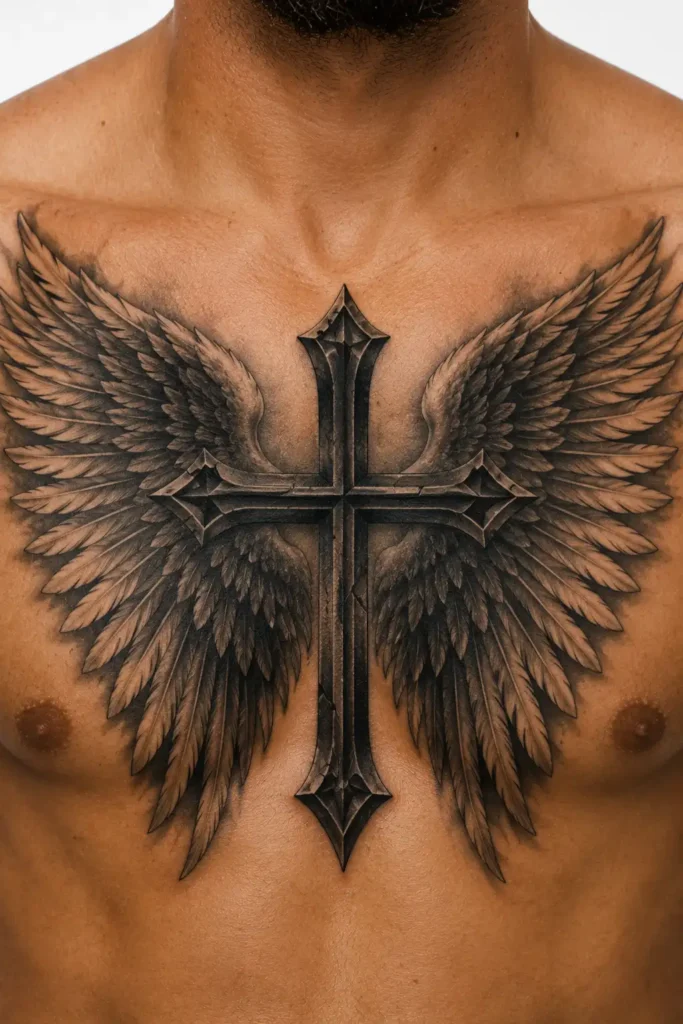
A cross with wings spread from its horizontal arm creates one of the most visually striking cross tattoo compositions available. The wings represent divine ascension, freedom, and the spiritual capacity to rise above earthly limitation. Combined with the cross, they create a composition that speaks to the specifically Christian hope of life beyond death and the specific freedom that faith makes possible.
A large cross with wings spanning the upper back or chest creates a design of extraordinary visual power and personal significance. This is one of the most popular back and chest tattoo compositions for both men and women who want a large-scale faith declaration.
Cross with Rosary Tattoos
A rosary wrapped around or hanging from a cross creates one of the most specifically Catholic devotional tattoo compositions. The rosary represents Marian devotion, the meditative prayer practice of the Catholic tradition, and the specific spiritual heritage of Catholic Christianity. For men and women with Catholic heritage and practice, a cross with rosary tattoo creates a design that honors both the central symbol of Christianity and the specific devotional form their practice takes.
Cross with Crown of Thorns Tattoos
The crown of thorns placed around a cross or at its base references the specific details of the crucifixion narrative and the mockery of Christ as the “King of the Jews.” As a tattoo, the crown of thorns represents the specific theology of redemptive suffering: the willingness to endure humiliation and pain in the service of something larger. It honors the dignity that remained even when external dignity was stripped away.
Crucifixion Tattoos (Jesus on the Cross)
A full crucifixion scene, depicting Jesus on the cross with the specific visual details of the crucifixion narrative, is one of the most ambitious and most personally significant Christian tattoo compositions available. This design requires a large canvas and an artist with genuine expertise in figurative work.
A well-executed crucifixion tattoo in realistic black and grey, with Jesus’s face rendered with the specific emotional quality of acceptance and love in the midst of suffering, creates a design of genuine devotional power. Combined with the thorny branches that evoke the crown of thorns, a crucifixion arm or back tattoo is a complete visual statement of the central Christian narrative.
Cross with Rose Tattoos
The rose with a cross is one of the most enduringly popular cross tattoo combinations and one of the most visually satisfying. The cross represents faith and devotion. The rose represents beauty, love, and the coexistence of beauty and pain in the same living thing. Together they create a design that honors both the spiritual and the human dimensions of love: the divine love represented by the cross and the earthly love represented by the rose.
A traditional black cross adorned with a red rose creates a bold, immediate design with clear symbolic content. A fine-line cross with delicate rose elements creates a more refined and subtly feminine interpretation of the same combination.
Cross with Angel Tattoos
An angel combined with a cross creates a design that layers two of Christianity’s most recognizable protective symbols. The angel as divine messenger and guardian alongside the cross as the central symbol of faith creates a composition of both spiritual declaration and protective intention. For memorial purposes, an angel watching over a cross with a name creates one of the most complete tribute tattoos available.
Cross with Dove Tattoos
The dove is the Christian symbol of peace, the Holy Spirit, and the divine presence. Combined with a cross, the dove creates a design that declares not just faith but the specific quality of peace that faith produces. Light rays extending from behind the cross alongside a dove in flight creates the classic imagery of divine presence breaking through from above.
Cross with Birds Tattoos
A cross surrounded by birds in flight creates a design of freedom and spirituality intertwined. Birds in flight symbolize the soul’s journey and the freedom of faith, capturing the essence of hope and guidance. Doves carry peace symbolism. Sparrows carry joy. The specific choice of bird type can be tailored to personal significance.
Cross with Anchor Tattoos
An anchor combined with a cross is one of the oldest maritime tattoo combinations, honoring the verse in Hebrews 6:19 that describes hope as “an anchor for the soul.” The anchor represents stability and groundedness in times of turbulent circumstance. Combined with the cross, it creates a design about faith as the stabilizing force that prevents the soul from being swept away by whatever storms arise.
Cross with Infinity Loop Tattoos
A cross with an infinity loop integrated into its base or surrounding it represents the eternal nature of faith: the love of God that has no end, the life beyond death that the cross promises, and the eternal quality of bonds formed in genuine love. This combination is particularly popular as a memorial design because it declares that love and connection do not end with death.
Cross with Compass Tattoos
A cross with a compass represents spiritual direction: the faith that orients the wearer’s life in the same way a compass orients a traveler. The combination suits men who define themselves by a sense of purposeful direction and who find that direction in their faith. It also represents the Christian idea that God provides guidance to those who seek it, pointing toward what matters when circumstances create confusion.
Cross with Name and Date Memorial Tattoos
A cross with a name and dates is the most direct memorial tribute format available in cross tattooing. The cross represents the belief that the person who has passed is held in divine care. The name preserves their specific identity. The dates anchor the tribute to the specific span of a human life. Together they create a design that is simultaneously a statement of faith and an irreplaceable personal tribute.

Cross with Butterfly Tattoos
A butterfly combined with a cross creates a design that pairs two powerful transformation symbols: the butterfly’s metamorphosis and the cross’s promise of resurrection. Together they represent the specific hope that what passes through death emerges transformed on the other side. This combination is particularly resonant as a memorial design for someone who died after a long illness.
Cross with Sun and Moon Tattoos
A cross with both sun and moon elements represents spiritual balance and the recognition that faith governs all dimensions of experience: day and night, the visible and the hidden, the active and the contemplative. This design suits people who find in their faith a framework for engaging with the full spectrum of human experience.
Cross with Crown Tattoos
A cross with a crown represents the specifically Christian theology of Christ as King: the belief that genuine authority is not the authority of force but the authority of love and sacrifice willingly undertaken. For men and women who identify with this understanding of what leadership and power mean, a cross and crown tattoo makes this declaration permanent.
Cross with Barbed Wire or Broken Chains
A cross combined with barbed wire or broken chains represents redemption through struggle: the specific experience of having been bound by addiction, trauma, harmful patterns, or destructive circumstances and finding freedom through faith. The barbed wire or chains in these designs are not the message. The cross is. The binding elements represent what was escaped, not what remains.
Watercolor Cross Tattoos
Watercolor cross tattoos apply soft, blended color without hard outlines to create designs that look painted rather than drawn. A watercolor cross can represent rebirth and renewal, making it a compelling choice for those who see their faith as an ongoing artistic and personal creation rather than a fixed declaration.
Cross with Heartbeat Line Tattoos
A cross combined with a heartbeat or EKG line creates a design that places faith and life together as inseparable: the heart’s beat and the cross that gives that heartbeat its ultimate meaning. This design is particularly resonant for healthcare workers whose professional lives are organized around the preservation of biological life within a faith-based understanding of what that life means.
Cross with Skull Tattoos (Gothic)
A Gothic cross with skull elements represents the Memento Mori tradition within Christian spirituality: the honest acknowledgment that death is real and that this acknowledgment makes every moment of life more deliberately lived. Far from being a contradiction, the skull on the cross reflects the cross’s own engagement with mortality as the path toward its deepest meaning.
Cross Tattoos for Men
Bold and Dramatic Cross Designs for Men
Men’s cross tattoos generally lean toward bolder, more dramatic interpretations. Heavy shading creates dimensional depth in a large black and grey cross. Bold outlines in traditional style create graphic power that reads from across a room. Dark atmospheric elements, including clouds parting to reveal the cross, rays of light extending from behind it, and banner inscriptions below it, create compositions of considerable visual ambition.
Bold cross designs for men suit the chest, back, and full arm where the canvas is large enough for the dramatic scale these designs demand. A large cross spanning the full back creates a design that is both architecturally powerful and deeply personal.

Celtic and Tribal Cross Tattoos for Men
Celtic and tribal cross tattoos are among the most consistently popular cross designs for men. The Celtic cross with its characteristic circle and knotwork detailing suits men with Irish, Scottish, or Welsh heritage who want a design that honors both their Christian faith and their specific cultural lineage. The Gaelic cross tends to be more elaborate and specifically tied to Irish heritage.
Tribal cross tattoos in bold black patterns create designs of maximum visual impact with cultural depth rooted in the specific tradition they draw from. These designs suit the upper arm, chest, and back particularly well.
Crucifixion and Religious Scenes for Men
Full crucifixion scenes and complete religious compositions are most commonly chosen by men who want a faith declaration that goes beyond the symbolic to the narratively specific. A realistic crucifixion on the chest or back requires sessions with an artist who specializes in figurative work and creates one of the most deeply personal and visually ambitious cross tattoo projects available.
Cross Sleeve and Large Scale Tattoos for Men
A cross-themed sleeve organizes the arm’s canvas around the central cross symbol and extends the composition through supporting religious elements: angels, doves, rays of light, roses, biblical verses, and the specific imagery of the Christian tradition. These projects are multi-session commitments that produce some of the most personally significant and visually unified tattoo collections available for men.
Cross Tattoos for Women
Small and Delicate Cross Tattoos for Women
Small cross tattoos for women are among the most consistently popular first tattoo choices available. A tiny cross behind the ear. A small fine-line cross on the inner wrist. A minimal cross on the collarbone following the bone’s natural line. These designs are simultaneously discreet and deeply meaningful, visible in the moments the wearer chooses and hidden in professional settings.
A rising trend is the small crucifix tattoo placed on the side of the finger: intimate, personal, and visible to the wearer in every daily gesture.
Floral Cross Tattoos for Women
Floral cross tattoos are the most consistently popular cross design category for women. Roses, lilies, wildflowers, and vines combined with the cross create compositions that balance spiritual declaration with natural beauty. Pastel color versions create a soft, elegant interpretation. Fine-line black and grey versions create refined, sophisticated designs. In both approaches, the floral cross honors faith without the visual weight that large bold cross compositions can carry.
Watercolor Cross Tattoos for Women
Watercolor cross tattoos create soft, painterly designs that suit women who want their cross to feel like living, breathing art on skin. The blended colors and soft edges of watercolor execution give the cross a quality of ongoing movement and renewal that suits its symbolism of living faith. This style requires a watercolor specialist and consistent sunscreen protection after healing.
Feminine Cross Combinations for Women
Cross tattoos for women are often personalized through specific combination elements that add personal meaning. Dates and initials alongside a small cross create intimate memorial designs. Small stars scattered around a collarbone cross create celestial context. A cross with delicate botanical elements creates a design rooted simultaneously in the spiritual and natural worlds. The combination elements transform a universally recognizable symbol into something specifically and irreducibly personal.
Cross Tattoo Styles
Realistic and Black and Grey
Realistic and black and grey execution suits the most emotionally significant cross compositions: the crucifixion, the portrait cross with memorial elements, the large cross with detailed surrounding elements. The dimensional depth of realistic technique allows complex cross compositions to achieve genuine presence and weight rather than appearing flat.

Fine Line and Minimalist
Fine line execution creates the most elegant and the most versatile cross tattoo designs. A single-needle cross in precise clean lines at any scale. Fine-line botanical elements around a cross in delicate detail. These designs age best on stable placements and suit everyone from first-time tattoo seekers to experienced collectors adding a meaningful minimal piece to their collection.
American Traditional
Traditional cross tattoos use bold outlines, flat color fills, and the classic visual language of American tattoo tradition. A traditional cross with a red rose. A traditional eagle and cross composition. A traditional cross with a banner and name. These designs age better than any other style because the bold outlines maintain their definition across decades.
Neo-Traditional
Neo-traditional cross tattoos add richer color palettes and illustrative complexity to the traditional approach. A neo-traditional cross with elaborate rose and vine elements. A neo-traditional Celtic cross with vivid green and gold coloring honoring its Irish tradition. These designs combine structural boldness with visual richness.
Blackwork
Blackwork cross tattoos use solid black ink in bold fills and precise linework for maximum visual impact. Celtic cross designs, tribal cross compositions, and large-scale Gothic cross pieces all suit blackwork execution. The bold graphic clarity of blackwork gives cross imagery an immediate visual authority.
Watercolor
Watercolor cross tattoos create ethereal, painted designs that feel alive rather than static. The blended color and soft edges suit women’s cross tattoos particularly well when the intention is elegance rather than declaration.
Geometric
Geometric cross tattoos construct the cross form from mathematical precision, creating designs that honor the symbol’s meaning while presenting it in unmistakably contemporary visual language. Sacred geometry patterns surrounding a cross create designs that bridge ancient symbolism and modern aesthetic sensibility.
Best Placements for Cross Tattoos
Chest (Closest to the Heart)
The chest places the cross in the most symbolically resonant position on the body: over the heart, the center of what the wearer values most. A large cross spanning the chest creates a design that is visible from the front as the wearer moves through the world, announcing faith with every encounter. For smaller, more personal chest cross designs, the area directly over the heart keeps the symbol in the most intimate possible proximity to the body’s emotional center.
Forearm and Arm
The forearm is the most popular placement for cross tattoos because it combines maximum daily visibility with manageable pain and excellent canvas for both small and medium designs. A cross forearm tattoo is visible to the wearer throughout the day as a constant faith reminder. It is easily concealed under long sleeves in professional settings. The forearm suits cross designs from minimalist fine-line to elaborate floral cross compositions.
Back
The back provides the largest canvas for ambitious cross tattoo projects. A large cross spanning the full upper back. A crucifixion scene covering the complete back. A Celtic cross with elaborate knotwork and background elements filling the back’s generous canvas. These designs are completely private in professional settings and reveal themselves with significant visual impact in casual contexts.
Wrist
The wrist is one of the most popular cross tattoo placements for women. A small cross on the inner wrist stays visible to the wearer throughout the day as a continuous faith reminder. The outer wrist makes the design more visible to others. Both suit minimalist and small cross designs that suit the wrist’s compact canvas. The wrist represents a delicate, spiritual vibe in cross placement.
Behind the Ear
Behind the ear is one of the most intimate cross placements: a tiny cross, a minimal Celtic symbol, or a small floral cross. This placement is visible when hair is tied back and hidden when it falls naturally, creating a private and personal relationship between the wearer and their faith declaration.

Neck
A cross tattoo on the neck is a bold and visible choice that creates a mysterious and impactful impression. The nape of the neck suits symmetrical cross compositions. The side of the neck suits smaller designs. Neck cross tattoos signal complete commitment to the symbol’s visibility and the wearer’s willingness to carry their faith declaration into every social and professional interaction.
Hand and Finger
A cross on the hand or finger is one of the most visible and highest-commitment cross placements. Crosses on the knuckles, the back of the hand, or the side of the finger create designs that are visible in every handshake and every daily gesture. Hand and finger placements involve higher pain levels and faster fading due to skin renewal rates and constant friction.
Ribs
The rib cage suits medium cross compositions that are private and personal. A cross on the ribs is intimate and selectively revealed, suitable for women who want their faith declaration to exist primarily in their own awareness rather than in constant public view.
Shoulder and Shoulder Blade
The shoulder and shoulder blade suit medium cross compositions and allow designs to extend toward the upper arm or across the upper back. The shoulder’s curved surface adds dimension to designs that wrap with the body’s natural contour.
Cross Tattoo Aftercare
Cross tattoos, particularly detailed realistic crucifixion scenes and elaborate Celtic cross compositions, require careful aftercare to preserve their line quality and tonal detail.
After every session keep the tattoo covered with your artist’s wrap for the first several hours. Wash gently twice daily with fragrance-free soap and lukewarm water. Apply a thin layer of fragrance-free moisturizer throughout healing. Avoid direct sunlight on fresh tattoo work. Do not scratch, pick, or peel healing skin. Fine-line cross work is particularly vulnerable to disruption during healing. Avoid swimming and water submersion for three to four weeks.
For color cross tattoos including watercolor and traditional colored compositions: apply SPF 50 sunscreen to any exposed area consistently after healing. Color tattoos degrade significantly faster than black ink work without consistent UV protection. This single habit extends the vibrancy of cross tattoo colors more than any other post-healing action.
How Much Do Cross Tattoos Cost?
Cross tattoo costs vary based on design complexity, style, size, and artist expertise.
A small minimalist cross tattoo of two to four centimeters, such as a simple fine-line cross, a tiny Celtic symbol, or a small cross on the wrist or behind the ear, typically starts at $80 to $250.
A medium cross tattoo of four to ten centimeters, such as a floral cross on the forearm, a Celtic cross with knotwork detail, or a cross with wings composition, typically runs $250 to $700.
A large cross tattoo, such as a detailed Celtic cross back piece, a crucifixion scene on the chest or back, or an elaborate cross and rose composition, typically costs $700 to $3,000 or more depending on complexity and the artist’s rate.
A full cross-themed sleeve or complete back piece typically costs $3,000 to $8,000 across multiple sessions.
How to Find the Right Artist for Your Cross Tattoo
For simple and minimalist cross designs: find a fine-line specialist whose portfolio demonstrates consistent, clean, confident linework. A simple cross that wobbles or loses its symmetry is one of the most immediately visible technical failures in tattooing.
For Celtic cross designs: find artists whose portfolio specifically shows Celtic knotwork and intricate linework. The complexity of authentic Celtic pattern work requires specific technical expertise and genuine knowledge of the design conventions.
For crucifixion and realistic cross scenes: find portrait and figurative artists whose portfolio shows human figures rendered with emotional depth and tonal accuracy. The face of Christ in a crucifixion tattoo requires the same portrait skill as any other meaningful figurative work.
For floral cross designs: find artists whose botanical and illustrative work demonstrates clean petal detail and confident organic line quality.
Always review healed examples in the artist’s portfolio. Fresh cross tattoos look sharp on most artists. Healed examples reveal whether the linework holds its precision and whether the tonal depth maintains its quality as ink settles.

Frequently Asked Questions
What does a cross tattoo symbolize?
A cross tattoo most commonly symbolizes Christian faith and spiritual devotion. It also represents sacrifice and the triumph over death, memorial tribute to loved ones, balance and direction at the intersection of earthly and eternal dimensions, and cultural heritage in traditions including Celtic, Egyptian, and Polynesian. The specific meaning depends on the type of cross and the individual’s personal connection to the symbol.
What is the difference between a Celtic cross and a Christian cross?
The Celtic cross, also known as the Irish cross, is distinguished by a circle surrounding the intersection of the arms. The circle represents eternity, God’s infinite love, and the continuous cycle of existence. The Celtic cross traditionally carries meanings of hope, faith, balance, unity, and the transition of seasons. The Christian Latin cross has no circle and represents the crucifixion and Christian faith in its most universal form.
What does an Ankh cross tattoo mean?
The Ankh is an ancient Egyptian symbol representing eternal life and immortality. Egyptian gods and goddesses are frequently depicted holding the Ankh. An Ankh tattoo represents the belief in the eternal nature of the soul, the union of masculine and feminine principles, and the specifically Egyptian spiritual tradition’s understanding of divine life. The loop at the top makes it immediately recognizable and creates a cross form with specifically feminine visual qualities.
Where should I place a cross tattoo?
The chest is the most symbolically resonant placement because it positions the cross closest to the heart. The forearm provides maximum daily visibility and excellent canvas for medium designs. The back suits the most ambitious cross compositions. The wrist suits small, delicate cross designs. Behind the ear suits intimate, discreet cross tattoos. The placement should reflect how you want to carry the symbol in your daily life: privately, publicly, or somewhere between.
Are cross tattoos only for Christians?
No. While Christian faith is the most common motivation for cross tattoos, people choose crosses for reasons including cultural heritage (Celtic, Egyptian traditions), memorial tribute to loved ones, the universal symbolic meaning of balance and direction, and pure aesthetic appreciation for the cross as a visual symbol. The cross tattoo tradition is broad enough to accommodate every motivation with genuine integrity.
What is the most popular cross tattoo design?
The simple or minimalist cross is the single most consistently requested cross tattoo design globally and is consistently one of the most popular first tattoo choices for both men and women. Among more elaborate designs, the floral cross (particularly with roses) is the most popular for women, and the Celtic cross is the most popular for men with heritage connections to Celtic traditions.
Final Thoughts
The cross tattoo is the oldest and most enduring symbol in the Western tattoo tradition for the simplest possible reason: it carries meaning that does not depend on what year it was chosen or what cultural moment surrounds it. Two thousand years of human beings marking this symbol on their bodies as declarations of faith, as tributes to those they have loved and lost, as connections to the heritage that produced them, and as acknowledgments of the invisible dimensions of existence have not diluted its power. They have accumulated it.
Choose the cross type that most honestly reflects what this symbol means in your specific life. Choose the combination elements that add the personal specificity your design deserves. Find an artist whose portfolio demonstrates genuine technical excellence in the specific style you want. Apply the stencil before committing. And when you carry your cross forward on your skin, know that you are participating in the longest-running continuous tattoo tradition the Western world has ever known.
